Gerry’s architecture office is firebombed in Derry
Midwinter BreakGerry’s architecture office is firebombed in Derry, an attack that destroys a place of creation and leaves its perpetrators and motive unknown. Remembered as Gerry watches news of burning buildings, the episode moves from the unanswered fact of the attack into an exacting inventory of what fire consumes: not just structures, but years of work and the materials through which imagined buildings might have become real.
The attack and its unresolved cause
The office stood in the Diamond in Derry. Gerry recalls that it was firebombed, but nobody ever discovered who was responsible or why. Watching television images of flames and black smoke, he considers possible perpetrators without claiming to know: perhaps, he thinks, young zealots egging one another on; he also thinks of the Provisional IRA and its readiness for petrol bombing. His anger sharpens around the contradiction between a political struggle and the destruction of buildings and books. He remembers that the Irish Republican Army had even tried to burn down the Linen Hall Library in Belfast, and asks himself what burning books could have to do with Irish freedom.
Imagining the destruction
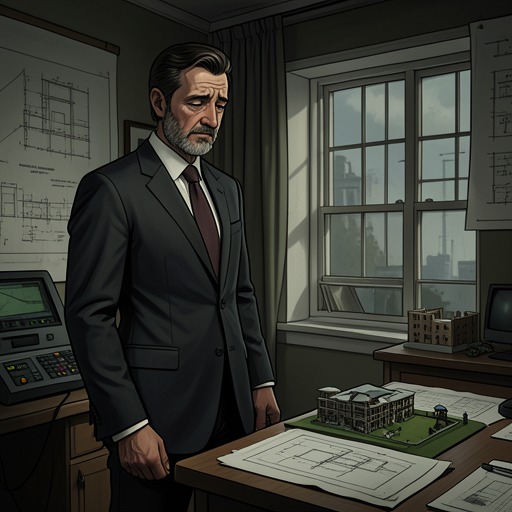
The recollection gives way to a miniature catastrophe staged in Gerry’s mind. He pictures an architectural office as a model city: plan chests, rolls of tracing paper, set squares, templates, and stencils among tiny cars and trees. In this imagined fire, flames would be reflected in cellophane windows; the small trees would burn down to black wire, and the buildings would collapse. The model of Burt Chapel, with its copper roof, becomes an inferno, its roof lit by apple-green flames. This imagined scale does not make the destruction trivial. It makes visible how many kinds of making are gathered in an architect’s workplace, and how quickly fire can erase them.
The vision expands from individual models to the accumulated labor behind them: drawings by Scandinavian and local architects, plans, notes, material lists, and measurements. Hours and days of work become ash. Gerry’s imagined miniature streets also recall Bombay Street, where Catholics were burned out by a Loyalist mob. The comparison places the office attack within a landscape of sectarian destruction, while keeping the acts distinct: one is the firebombing of Gerry’s workplace; the other is the burning of a neighborhood and its residents’ homes.
The aftermath and what remains
When Stella hears about the office, her response is relief that nobody was killed: “Nobody was killed, thank God.” The next morning Gerry walks carefully through the devastation, searching for anything salvageable. The surviving room bears the physical marks of the fire: wood blackened like alligator skin, light shades hanging in distorted shapes, and venetian blinds warped by heat. A few biscuits lie by his shoe, incongruously appearing fit to eat amid the ruin.
The smell is another remnant, less visible but harder to leave behind. Gerry remembers that it took weeks for it to come out of his clothes, and even then he could not be sure it was gone. The office’s destruction thus persists beyond the burned objects: a place of architectural creation has been savaged, and the sensory trace of its loss follows him after he has left the wreckage.